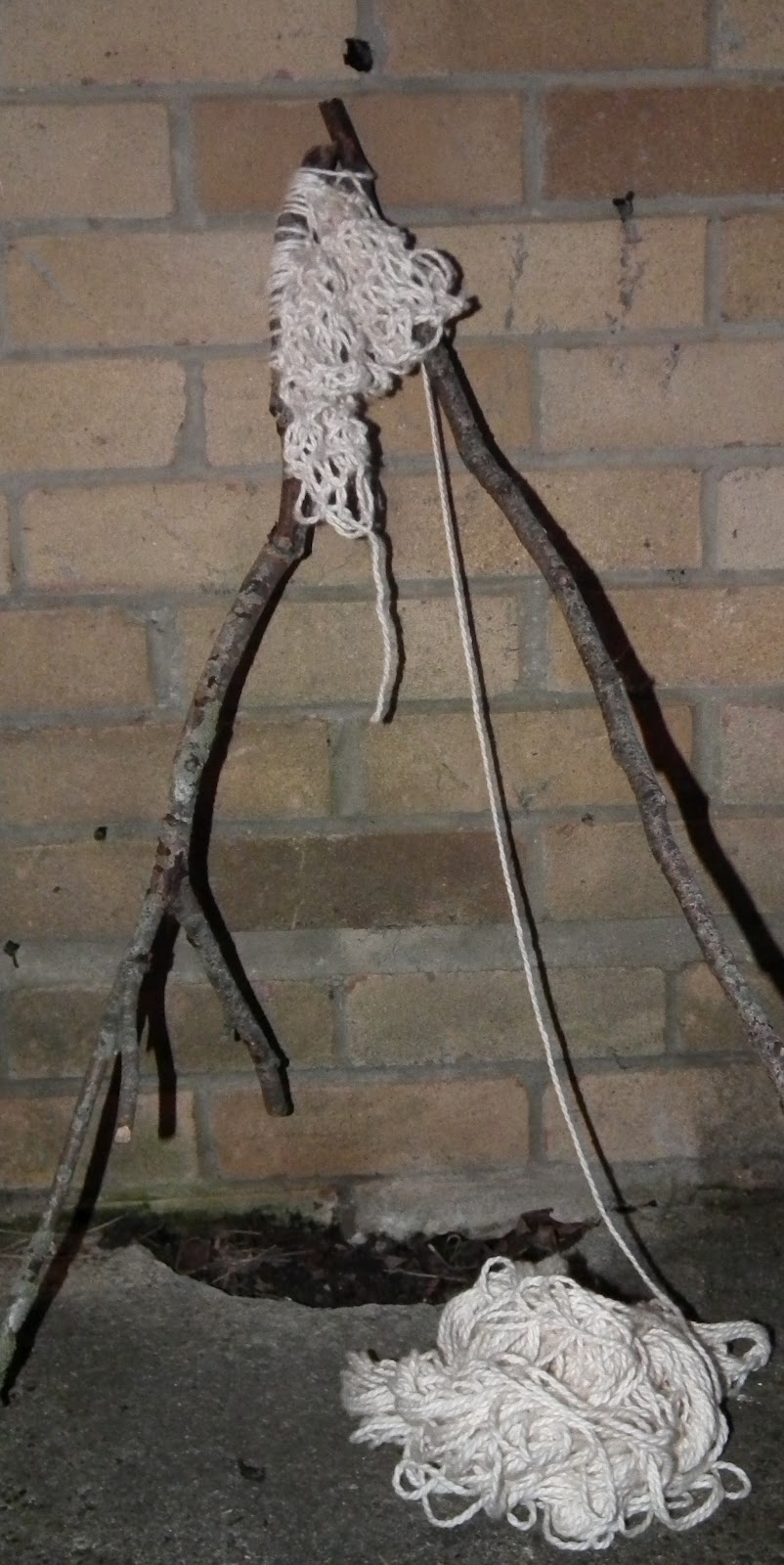
For the Shepherd's Cottage it seemed appropriate to use wool and again I wanted to use natural elements that were around. I found two long branches and began knitting with untreated wool. This process was quite frustrating - the thin bits on the ends of the branches snapped off, shortening the length. Other problems such as transferring the stitches branch to branch was difficult as I didn't want them pointed at the end. While I was knitting the piece it started to look like a white flag and I began to think of the notion of surrender...........
Wednesday, 15 February 2012
Saturday, 28 January 2012
The making of George's Smock
This piece has been made in response to one of the great characters in Tyneham. George Richards lived in a run-down cottage on the north side of the village, he was the last person in Tyneham to wear a smock, all his life he had been a farm labourer and is remembered as a very old man tending to the turnips in the fields.
You could tell a person’s trade by his smock. If you were a shepherd you would have a crook embroidered but George’s smock was different; his had flowers and leaves and it often was a conversation piece as no one knew where it came from.
This smock has been a labour of love for me. It has taken almost 100 hours from start to finish but despite having to teach myself how to follow a pattern and smock something I’ve never done before I’ve really enjoyed seeing it progress. This craft is a dying trade and there aren’t many people making them now and I can see why. When people only had each other for company it seems a lovely way to while away the hours.
I have hand stitched everything apart from the assembly of the garment which I did on my sewing machine. The stitches, both the smocking and embroidery are traditional and used during the time George would’ve owned his smock.
Measuring the fabric - old bed sheets
Trying to follow the pattern
Smocking Dots
The long task of joining the dots
The first pull.......
........smocking is addictive
the top of the sleeves.....
.....and the bottom
The back of the smock
It looks like I measured right.
Detail of the front and back
The embroidered panels from left to right, collars, yokes and cuffs, showing leaves and flowers
Yoke detail in chain stitch
Hours of work
Assembling the smock........11 hours later........
Almost finished........
A dress for Phyllis
This piece is one of three that will hang on an old washing line in the Laundry House which still has a copper boiler. Phyllis is the name of the daughter of the couple who lived and worked in The Post Office, but the name also means green leaves, foliage….which I thought was quite fitting.
Tear
tears - A profusion of this liquid spilling from the eyes and wetting the cheeks, especially as an expression of emotion.
I’ve stitched dried ivy leaves and some keys that belonged to a luggage trunk from the 1940’s….the tags that came with these shows the inventory for winter and summer clothes. I wonder what happened to the trunk and the contents. I would like to add more to this piece perhaps embroidering keys and other items on to give it a more textural feel.
Dress detail
In addition to the dress I have made an aged handkerchief to hang next to the dress
Tear
tears - A profusion of this liquid spilling from the eyes and wetting the cheeks, especially as an expression of emotion.
v. tore, torn, tearing, tears.
v.tr.
To pull apart or into pieces by force; rend.
To make (an opening) by ripping
To separate forcefully; wrench
To divide or disrupt
The Gardener's Cottage
In amongst the ruins of the roofless properties nature has taken over. Small plants grow up high making a home in the abandoned cottages. I have created a number of different pieces mainly to go into the Gardeners Cottage including knitted leaves which will be placed among real plants and embroidered lichen which will be attached to branches.
This is another piece I am currently working on which is called ‘No Welcome Home’. During my visits to Tyneham I have collected wood and branches that have fallen around the cottages. I have used a band saw to cut these into small buttons which I will stitch onto cloth. This will then form a rug which I will put in front of one of the old fireplaces in the cottage.
The Old Needlecase
I have read many accounts of the villagers who lived in Tyneham and one lady who stands out is Helen Taylor, she worked for many years as a seamstress for the Manor House in Tyneham. On the day the village had to be evacuated Helen pinned a note to the church door.
It read:
‘’Please treat the church and houses with care. We have given up our homes where many of us lived for generations to help win the war to keep men free. We shall return one day and thank you for treating the village kindly’.
This needle case is from an old sewing box. The needles have aged and rusted it, hand-made it once belonged to someone alongside other pieces in the box that I bought. When things like this end up in a sale it is sad to think they are not worth anything anymore.
I have decided to use it as an embroidered piece for my exhibition, so that the owner can be thought of through the memory of Tyneham. I have started to stitch the message that Helen left at the church.
Disperse dye, heatpressed onto torn polyester
Stitching Helen's message
Image of what the needlecase would like like on the windowsill of the Seamstresses Cottage
Sunday, 27 November 2011
All the small things....
In the derelict cottages at Tyneham nature has moved in. Leaves blow and swirl in the breeze, entering through open doors, settling in unused corners. Dry and representing all the colours of Autumn, I want some of my work to reflect this change so I began to stitch nature. I don't want obvious pieces in all of the properties, some I would like the viewer to notice only as they take a closer look. A reminder perhaps of how delicate life is.
Lichen on a twig collected from the wood at Tyneham
I have used free embroidery to recreate the lichen on my sewing machine and finished off sewing by hand
Lichen on a twig collected from the wood at Tyneham
I have used free embroidery to recreate the lichen on my sewing machine and finished off sewing by hand
Using different materials
Dried fern and machine embroidered sample
Free embroidered ivy leaf stitched onto hand made paper
Stitched onto ivy
with burnt silk
Leaves with copper foiling stitched onto hand made paper
Silk smocked
Trapped leaves and lace in plastic wallet and melted with an iron
Subscribe to:
Posts (Atom)

